Why Do I Keep Overdrafting? It's the Same Week Every Month, and That's the Clue.
The short version
- The median US household keeps exactly 14 days of spending in checking, and the most common pay gap in America is 14 days. There is no slack in that arrangement by design.
- 48.6% of households hold less than the 14-day gap requires.
- Bills anchor to dates. Paychecks arrive every 14 days, on a cycle that doesn't divide into a month. The two drift against each other, and some stretches come out long.
- Overdraft fees are charged per payment, not per day. Four small debits on one afternoon is $107, not $27.
- The fix is usually a date, not a dollar. Most billers will move a due date if you ask.
If you overdraft, you’ve probably noticed something about yourself that you may not have said out loud: it’s always the same week.
Not randomly scattered through the month. The same stretch, over and over, with a kind of grim reliability. And because it keeps happening, and because you keep telling yourself it won’t happen again, the natural conclusion is that the problem is you.
I want to make an argument against that, and it isn’t a pep talk. It’s this:
A character flaw wouldn’t have a schedule.
If the same week does it every month, something structural is producing it. And structural things can be looked at.
Your buffer is exactly one pay cycle
Start with the size of the cushion, because it explains more than anything else here.
The Federal Reserve’s household survey puts the median US checking balance at $2,803. On its own that’s an uninteresting number. Divide it by what a household at that spending level actually spends in a day, and it becomes a very interesting one:
14 days.
The most common pay cycle in America is every two weeks. Also fourteen days.
So the typical American checking account holds, near enough, exactly the amount needed to reach the next paycheck. Not comfortably. Exactly. Break-even, on a month where nothing unusual happens.
That’s the median, which means half of households are underneath it. Compare each household to its own 14-day requirement and 48.6% fall short — not “would find it tight”, but genuinely cannot get from here to payday on what’s in the account.
And the floor is lower than most people picture:
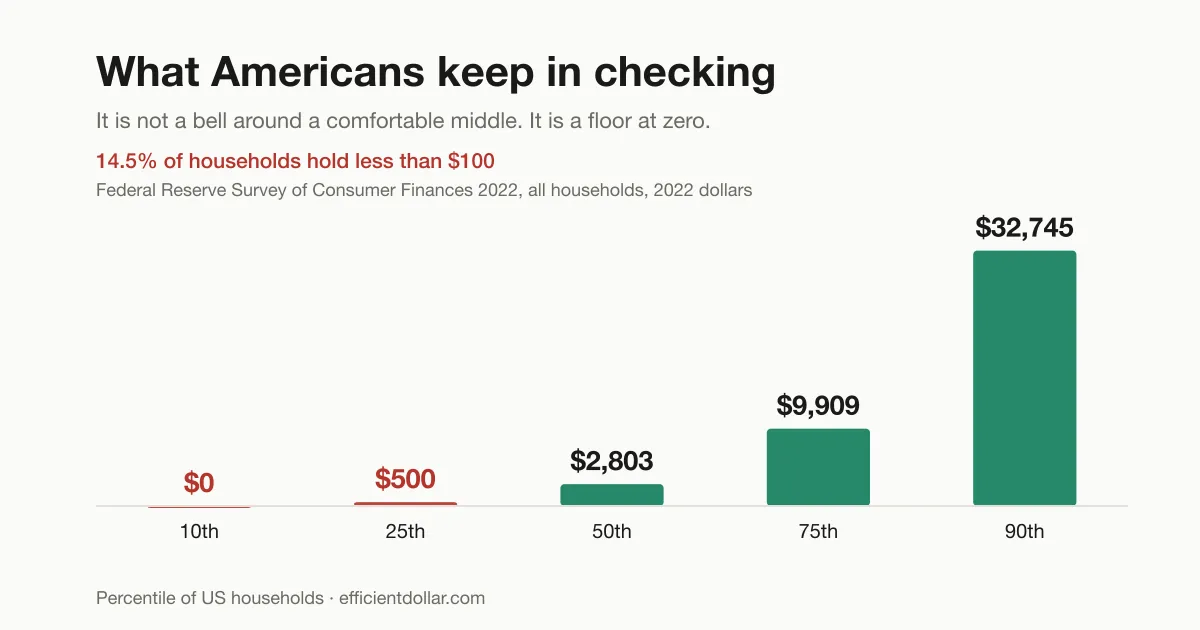
The 10th percentile is $0.00. One in seven households holds less than $100. Whatever you’re doing, you are not doing something unusual.
I broke these down by income and age in how much should you keep in checking, and the short version is that the bottom fifth of earners holds 2.9 days of spending while the top fifth holds 32.8. Same country, wildly different amounts of room for a bill to land early.
Two calendars that never line up
Here’s the part almost nobody has had explained to them.
Bills live on dates. Rent on the 1st. Car payment on the 5th. Utilities somewhere in the middle. They come back to the same numbered day every month, forever.
Paychecks live on a cycle. If you’re paid every two weeks, your paydays are 14 days apart — and 14 does not divide into a month. So your payday drifts. It’s the 6th this month, the 20th, then the 3rd. It slides backwards through the calendar all year.
Two rhythms, sliding past each other. Most months they interleave fine. But because one is drifting and the other isn’t, the spacing between them keeps changing — and every so often you get a stretch where a pile of dated bills sits inside a long gap between paydays.
That stretch is your week.
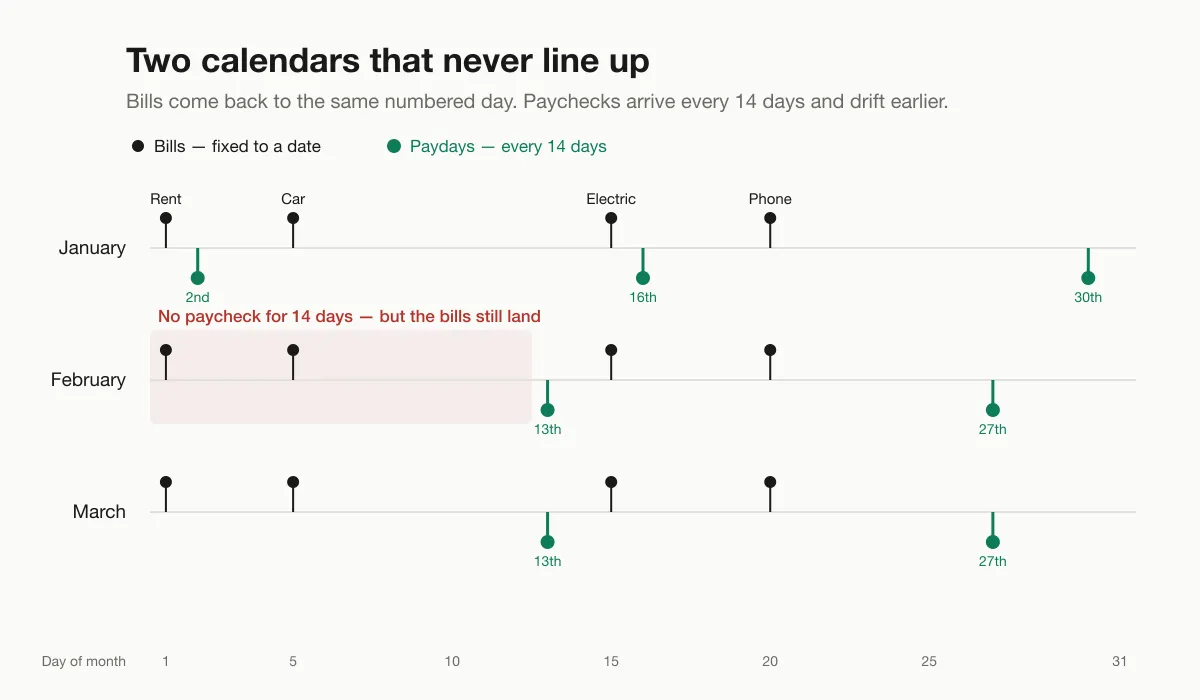
Illustration, not measured data: we have no dataset of real household bill due dates. The clustering of bills near the 1st and the 15th is a well-known pattern rather than something measured here. The paydays above are a real 14-day sequence, so the drift is arithmetic — but the bills are drawn.
The same drift produces something people find much more pleasant and are far more likely to have noticed: the three-paycheck month. Twice a year, a biweekly schedule squeezes 27 paydays’ worth of drift into a calendar and drops a third check into a single month. People love those months.
They’re the same phenomenon. The drift that hands you a bonus month in March is the drift that strands you in a long stretch in July. You just don’t get a notification about the second one. (Our paycheck bill calendar will show you both, six months out, if you want to see where yours fall.)
Find out which day yours is
Our free overdraft predictor walks your balance forward through every bill and paycheck for the next five weeks, and names the day it crosses zero — and the bill that tips it.
Check my next five weeksWhy one bad Thursday costs so much more than you think
This is the piece of the puzzle that surprises almost everyone, and it’s worth knowing even if you never overdraft again.
The average overdraft fee is $26.77, and 94% of checking accounts still charge one, according to Bankrate’s 2025 survey of checking accounts.
But the fee is per payment, not per day.
Sit with that for a second, because the consequences are not intuitive:
- Being $40 under water for six days, with nothing else coming out, is one fee. $26.77.
- Being $40 under for a single afternoon, while a coffee, a subscription renewal, a gas station stop and a grocery run all clear, is four fees. $107.08.
Same shortfall. Same amount of money missing. One of them costs four times as much, and the one that costs more is the shorter one.
Some banks cap the number they’ll charge in a day — Chase, for instance, stops at three, up to $102. But that’s a policy, not a rule, and plenty of accounts have no cap at all. Meanwhile a growing number of banks have dropped the fee entirely, which is worth five minutes of your time to check, because the difference between your bank and the one down the road might be the entire problem.
This is also why a shortfall of $63 is worth solving even though $63 sounds survivable. The shortfall is not what it costs you.
What actually fixes it: move the date, not the money
If the problem were “not enough money”, the fix would be “get more money”, and that advice would be useless because you’d have thought of it.
But the problem, for a lot of people in this situation, is not enough money on a particular Tuesday — while there was enough on the Friday before and there’ll be enough on the Friday after. That’s a different problem, and it has a much better fix.
Move a due date. This is the single most underused lever in personal finance. Credit card issuers will change your payment date over the phone in a couple of minutes; it’s a routine request and they’ll usually do it while you wait. Utilities, insurers, phone carriers and most subscription services will too. If one bill is landing in the wrong week — and it usually is one bill — moving it to the far side of your next paycheck fixes the month permanently, not just this month.
Pause anything that renews inside the bad stretch. A subscription renewing two days before payday is the easiest possible thing to move out of the way.
Consider turning off overdraft coverage. This sounds backwards and often isn’t. With coverage off, a payment that would overdraw you gets declined instead of paid-and-charged. A declined card is a bad ten seconds at the register. Four fees is $107 and a worse month.
Know the date. Not the balance — the date. Looking at your balance tells you where you are; it tells you nothing about what’s between here and payday. Every one of the fixes above requires you to know which day breaks, and far enough ahead to make a phone call.
That’s the whole reason we built the overdraft predictor: it takes your balance, your next payday and your bills, and gives you a date instead of a feeling. It’ll also tell you which single bill, moved, would fix the whole stretch.
The part worth keeping
Nearly half of American households can’t cover the gap to their next paycheck out of checking. The median household is running at exactly break-even against a cycle that drifts against the calendar all year. And the penalty for getting the timing wrong is charged per item, which turns a small miss into a large one.
None of that is a story about willpower. It’s a story about arithmetic that nobody shows you, running underneath a month that nobody laid out.
You can lay it out. That’s most of the fix.
See your next five weeks
Balance, payday, bills. You'll get the day your balance goes under, the bill that does it, what it would likely cost in fees, and the one due date worth moving. Nothing you type leaves your browser.
Open the overdraft predictorSources
Checking balances are from the Federal Reserve’s Survey of Consumer Finances 2022, weighted, with each statistic computed inside all five of the survey’s imputations and averaged. Spending is from the BLS Consumer Expenditure Survey 2024. Overdraft fee figures are from Bankrate’s 2025 checking account survey (fielded 2 June – 3 July 2025) and Chase’s published fee policy. Full method, including the validation against three statistics the Fed publishes itself, is in how much should you keep in checking.
Know what's actually safe to spend
Efficient Dollar tracks every account you connect and every bill automatically, then gives you one number each day: what you can spend without breaking anything later, including the bills that haven't hit yet.
Get early access